
In the construction industry, precision and efficiency are everything. Whether you’re working on residential buildings, commercial projects, or large infrastructure developments, steel reinforcement plays a critical role. One of the most important processes in handling reinforcement bars (rebars) is bending them accurately. This brings us to a common question: Bar Bending Machine vs Manual Bending – which is better?
In this detailed guide, we’ll break down both methods, compare them across multiple factors, and help you decide the best option for your project.
Manual bending is the traditional method of shaping steel bars using simple tools like bending plates, pipes, and manual force. This method has been used for decades, especially in small-scale construction projects.
While manual bending may seem cost-effective initially, it comes with several limitations that can impact project efficiency and quality.
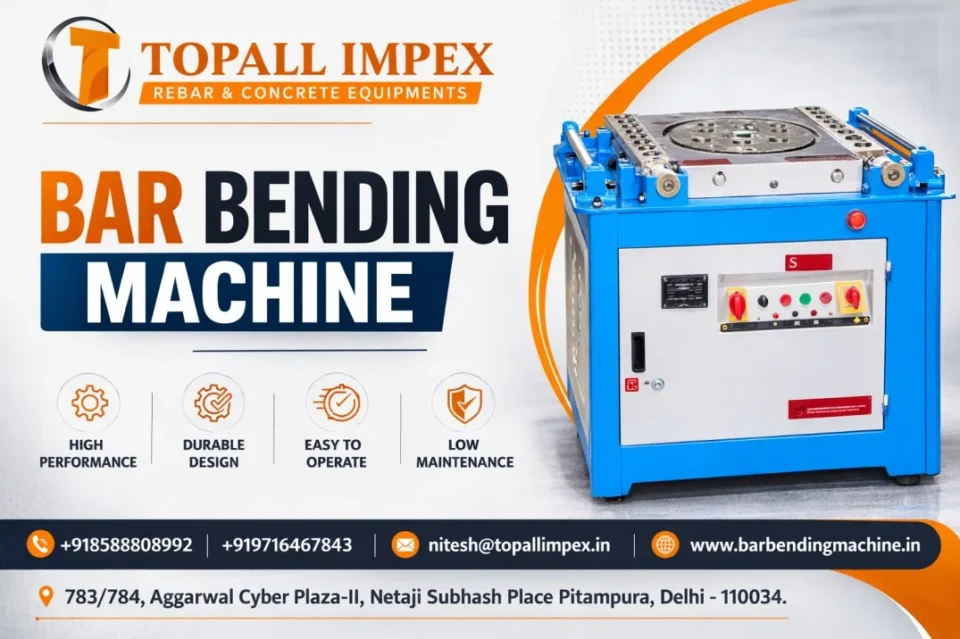
A Bar Bending Machine is a modern construction tool designed to bend steel bars with high precision and efficiency. These machines can handle different bar diameters and angles with minimal human effort.
Companies like Topall Impex manufacture advanced bar bending machines that are widely used across construction sites in India.
Let’s compare both methods based on important factors:
Manual Bending:
Accuracy depends on worker skill. Human error is common, leading to inconsistent bends.
Bar Bending Machine:
Delivers precise and repeatable bends every time. Ideal for projects requiring strict quality standards.
👉 Winner: Bar Bending Machine
Manual Bending:
Slow process, especially for large quantities. Requires more time and manpower.
Bar Bending Machine:
Can bend multiple bars quickly, significantly increasing productivity.
👉 Winner: Bar Bending Machine
Manual Bending:
Requires skilled labor and physical effort, leading to fatigue and inefficiency.
Bar Bending Machine:
Requires minimal manpower and reduces dependency on skilled labor.
👉 Winner: Bar Bending Machine
Manual Bending:
Low initial investment but higher long-term labor costs.
Bar Bending Machine:
Higher upfront cost but reduces labor expenses and increases efficiency over time.
👉 Winner: Depends on project scale
Manual Bending:
Difficult to maintain uniformity in bending angles and shapes.
Bar Bending Machine:
Ensures consistent output, which is crucial for structural integrity.
👉 Winner: Bar Bending Machine
Manual Bending:
Higher risk of injuries due to physical effort and improper handling.
Bar Bending Machine:
Designed with safety features to reduce workplace accidents.
👉 Winner: Bar Bending Machine
Manual Bending:
Best for small, low-budget projects.
Bar Bending Machine:
Ideal for medium to large construction projects.
👉 Winner: Depends on requirement
Using a Bar Bending Machine offers several benefits:
Despite its limitations, manual bending still has some benefits:
Manual bending is suitable when:
A Bar Bending Machine is the better choice when:
Imagine working on a large commercial building project. You need to bend hundreds of steel bars daily with precise angles. Manual bending would not only slow down the process but also lead to inconsistencies.
On the other hand, using a Bar Bending Machine from Topall Impex can help you complete the work faster, maintain quality, and reduce overall costs.
While manual bending may appear cheaper, it often leads to:
A Bar Bending Machine, although expensive initially, provides better ROI by:
If you are still wondering “Bar Bending Machine vs Manual Bending – which is better?”, here’s a simple answer:
Overall, Bar Bending Machines clearly outperform manual bending in terms of speed, accuracy, safety, and long-term cost efficiency.
The construction industry is evolving rapidly, and relying solely on traditional methods like manual bending can limit your growth. Investing in modern machinery such as a Bar Bending Machine is not just a choice—it’s a necessity for staying competitive.
Trusted manufacturers like Topall Impex provide reliable and high-performance machines that help businesses improve productivity and maintain quality standards.